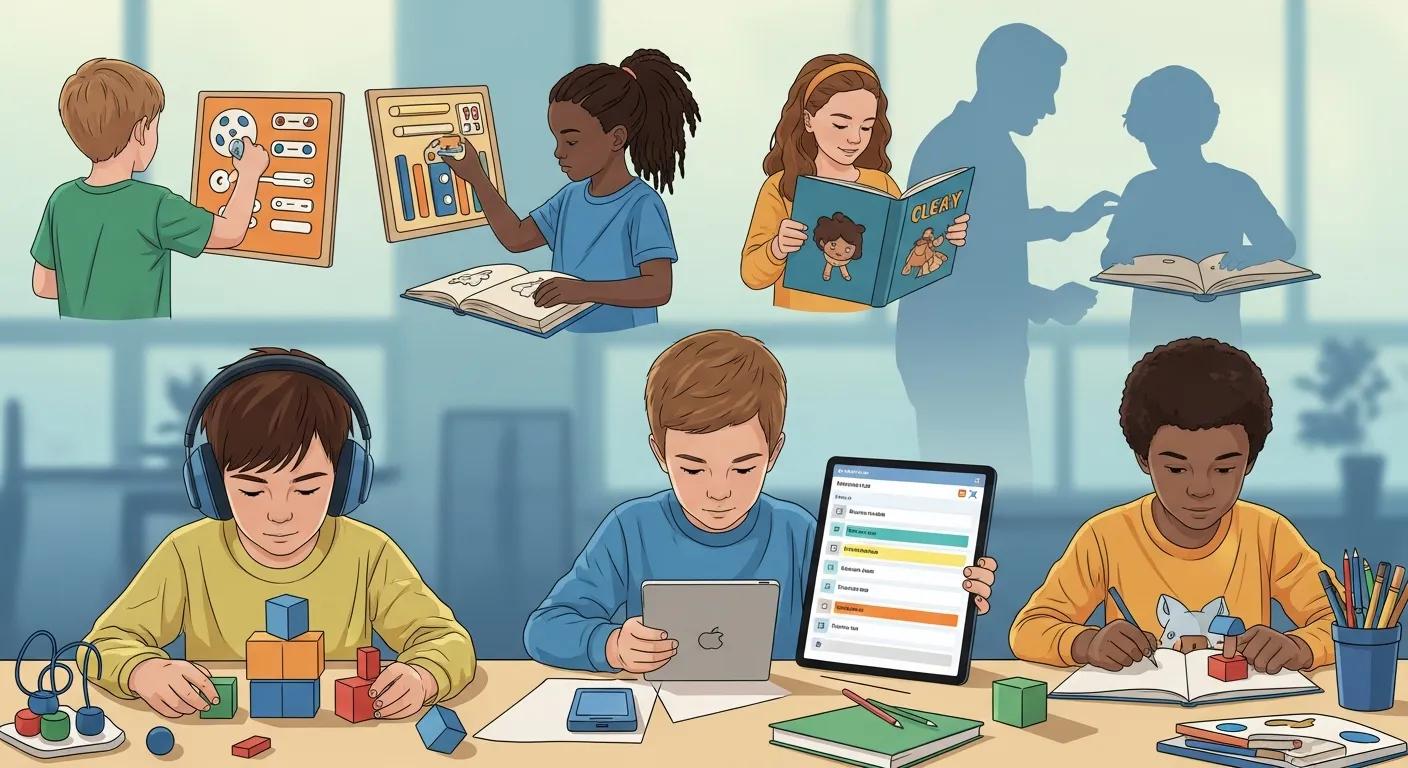
Choosing autism therapy tools can feel overwhelming for parents. This guide breaks down proven supports—ABA techniques, communication aids and sensory devices—and explains how each helps with behaviour, communication and measurable progress. Understanding these options makes it easier to find resources that support your child's development. We'll cover top tools, sensory devices, tracking systems, parent training and recent innovations.
Therapy tools help children with ASD build communication, social skills and adaptive behaviour. ABA-based tools target positive behaviours and reduce challenging ones through reinforcement. Communication aids enable children to express needs, and visual supports improve comprehension and engagement during learning.
ABA tools use personalised plans and reinforcement to teach skills and reduce problem behaviours. They focus on measurable goals and frequent practice. Training parents and caregivers to apply strategies at home ensures consistency across settings and boosts long-term behavioural gains.
Communication aids such as PECS and speech-generating devices let children convey needs visually or with synthesized speech. Used alongside speech therapy, they provide multiple routes to build language. Parent training ensures caregivers can use these tools reliably in everyday routines.
Research shows systems like PECS can significantly improve communication skills and speech development in children with autism.
PECS: Enhancing Communication Skills in Children with Autism
Few studies on augmentative and alternative communication (AAC) systems have addressed the potential for such systems to impact word utterances in children with autism spectrum disorders (ASD). The Picture Exchange Communication System (PECS) is an AAC system designed specifically to minimize difficulties with communication skills experienced by individuals with ASD. The current study examined the role of PECS in improving the number of words spoken, increasing the complexity and length of phrases, and decreasing the non-word vocalizations of three young children with ASD and developmental delays (DD) with related characteristics. Participants were taught Phases 1–4 of PECS (i.e., picture exchange, increased distance, picture discrimination, and sentence construction). The results indicated that PECS was mastered rapidly by the participants and word utterances increased in number of words and complexity of grammar.
Effects on communicative requesting and speech development of the picture exchange communication system in children with characteristics of autism, JB Ganz, 2004
Sensory integration devices address sensory processing differences that can distract or overwhelm a child. Tools that help regulate sensory input—so a child can attend and participate—support more productive therapy sessions. Adding sensory supports creates a more complete approach that meets both behavioural and sensory needs.
Common sensory tools include weighted blankets, fidget items and sensory swings. These supports can reduce anxiety, increase focus and create a calmer setting for learning. When used appropriately, sensory equipment helps children engage more fully with therapeutic activities and improves overall intervention effectiveness.
Recognising how these specialised tools work can turn daily sensory challenges into manageable successes for people with Sensory Processing Disorder.
Sensory Processing Disorder Tools for Autism Support
Transforming daily challenges into triumphs, sensory processing disorder tools provide essential support for individuals seeking to manage their unique sensory needs and thrive in a world that often overwhelms. For those grappling with Sensory Processing Disorder (SPD), everyday experiences can feel like a battlefield. The gentle rustle of leaves might sound like a roaring thunderstorm, or a soft cotton shirt could feel like sandpaper against the skin. It’s a world where the senses are dialed up to eleven, and finding balance can seem like an insurmountable task.
Sensory Processing Disorder Tools: Essential Aids for Managing Sensory Challenges
Sensory tools work alongside behavioural interventions by reducing overload or boosting under-responsive input. Integrating these tools into sessions makes the environment more adaptable to a child's needs, which increases comfort and participation and supports better learning during therapy.
Progress tracking systems give parents and clinicians a clear view of how interventions are working over time. Regular data collection and review help ensure therapies remain targeted to the child's evolving needs and support timely adjustments to treatment plans.
These tools measure effectiveness through direct observation, standardised assessments and parent reports. Combining multiple data sources provides a fuller picture of development and helps clinicians make evidence-based changes to strategies when needed.
Choose tracking systems with simple interfaces, customisable metrics and options to include parent input. These features make it easier to document measurable progress and tailor treatment plans, while keeping families actively involved in the therapy process.
Training resources help parents apply therapy techniques at home. Workshops, online courses and local programmes offer practical guidance and tools to reinforce learning between sessions. Ongoing education and support increase the likelihood of consistent progress.
Effective parent training often includes hands-on coaching from Board Certified Behavior Analysts (BCBAs). These programs teach parents to implement ABA strategies consistently, offer feedback and build confidence so the child benefits from uniform supports across settings.
Caregivers can access materials through community centres, online platforms and autism organisations. These sources typically offer workshops, webinars and downloadable resources. Peer networks and support groups also provide practical tips and encouragement.
Autism therapy tools are evolving with technology-driven solutions that personalise support. New platforms use data to adapt activities to a child's needs, aiming to increase engagement and provide actionable insights for therapists and families.
Interactive technology tools use gamified activities and analytics to make learning engaging and measurable. They can track performance, highlight trends and guide targeted interventions, helping clinicians and parents focus on specific areas that need attention.
Further research demonstrates how specially designed tablet games can automatically recognize and monitor therapy progress among children with autism spectrum disorder.
Tablet Games for Monitoring Autism Therapy Progress
The article presents a research study on recognizing therapy progress among children with autism spectrum disorder. The progress is recognized on the basis of behavioural data gathered via five specially designed tablet games. Over 180 distinct parameters are calculated on the basis of raw data delivered via the game flow and tablet sensors - i.e. touch screen, accelerometer and gyroscope. The results obtained confirm the possibility of recognizing progress in particular areas of development. The recognition accuracy exceeds 80%. Moreover, the study identifies a subset of parameters which appear to be better predictors of therapy progress than others. The proposed method - consisting of data recording, parameter calculation formulas and prediction models - might be implemented in a tool to support both therapists and parents of autistic children. Such a tool might be used to monitor the course of the therapy, modify it and report its results.
Automatic recognition of therapy progress among children with autism, A Kołakowska, 2017
Recent studies show that tailoring ABA to each child's needs improves engagement and outcomes. Personalised plans, early intervention and regular assessment help therapists target the most relevant skills and adjust approaches as the child progresses.
Want more information or to contact us? Visit our website.
Our friendly team is here to help!
Book a call with one of our Clinical Directors today!