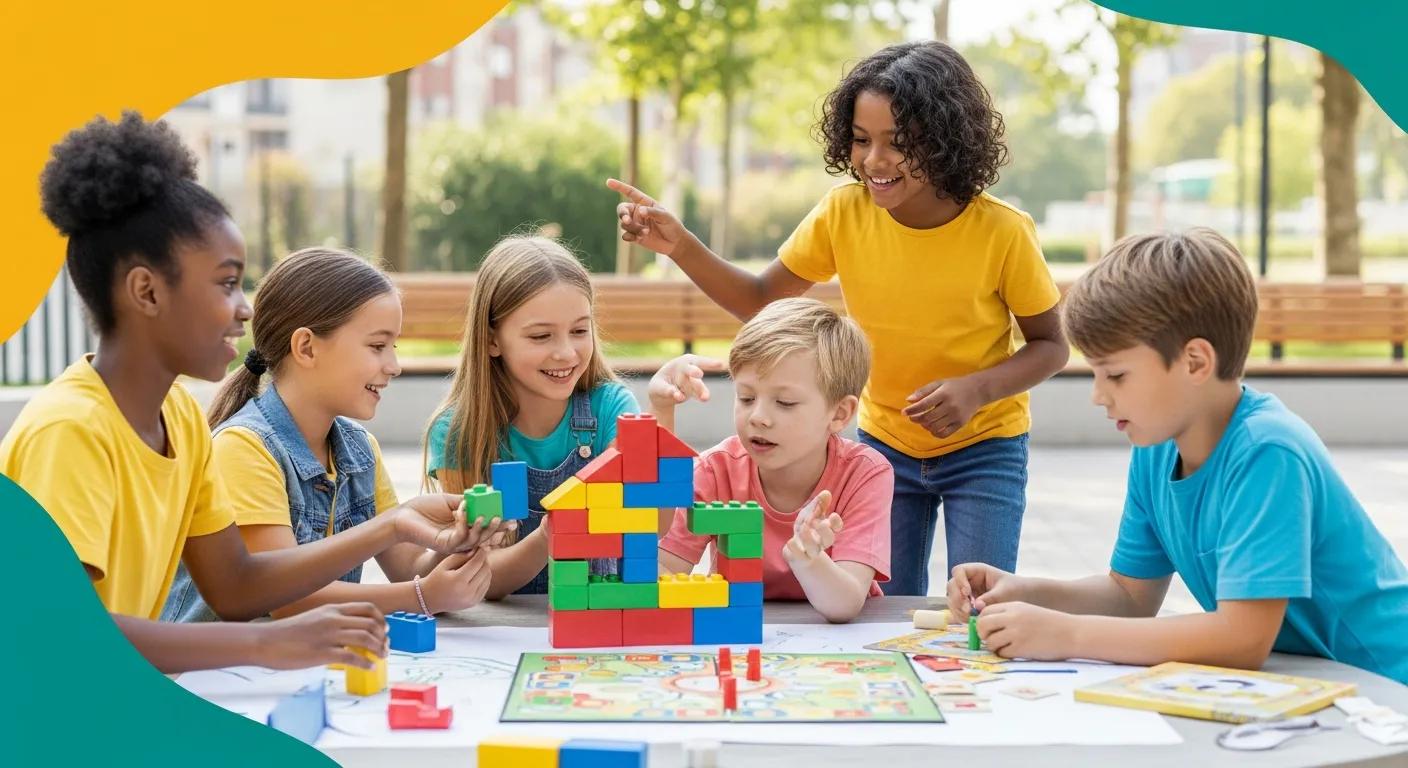
Social skills help children get around their environment, form relationships, and communicate. Children with Autism Spectrum Disorder (ASD) often face specific barriers to learning these skills. This guide explains the challenges autistic children encounter, the therapies that can help, and how parents and caregivers can support progress. Understanding social skills training lets families prepare children to thrive socially and emotionally. We cover therapeutic approaches, the parent's role, and recent research on social skills therapy for autism.
Children with ASD commonly face social challenges that make interacting with peers and adults harder. These show up as trouble reading social cues, starting conversations, or keeping friendships. Such difficulties can lead to isolation and frustration for both the child and their family.
Autism changes how children perceive and respond to social signals. Many autistic children find it hard to read facial expressions, tone of voice, or body language. That can cause misunderstandings and make starting or holding conversations difficult and overwhelming.
Research shows a clear need for effective interventions that target core social communication deficits in children with ASD.
Evidence-Based Social Communication Interventions for ASD
Impairments in social communication are a core feature of ASD. These include deficits in social-emotional reciprocity, non-verbal communicative behaviors used for social interaction, and difficulties in developing, maintaining, and understanding relationships. Research has focused on developing and summarising evidence-based practices that specifically target these social communication impairments and on outlining the strategies shown to work.
Evidence-based social communication interventions for children with autism spectrum disorder, 2017
Several social skills are commonly affected in autistic children, including:
These gaps show why targeted interventions are necessary to support social development in autistic children.
Various therapeutic programs aim to boost social skills. Each uses different strategies and provides structured settings where children can practise and build social abilities.
Applied Behavior Analysis (ABA) uses positive reinforcement to teach social behaviours and reduce barriers to interaction. Therapists often use role‑play, social stories, and repeated practice so children can learn how to navigate social situations more effectively.
In addition to ABA, several other interventions can improve social skills, including:
PEERS® Social Skills Training has shown strong results in improving social skills for autistic adolescents, including when delivered in hybrid formats.
Efficacy of PEERS® Social Skills Training for Autistic Adolescents
The study tested the Polish adaptation of the PEERS® curriculum with 29 adolescents (aged 11–16) who were randomised into a Treatment group and a Waitlist Control group. Due to COVID‑19 restrictions, the Treatment group received part of the intervention online (hybrid mode). Results showed large effects: increases in social skills, knowledge about social skills, and the number of peer get‑togethers. Most effects were maintained at a six‑month follow‑up, and delivery mode did not alter outcomes. The study supports the feasibility and efficacy of the Polish PEERS® adaptation and encourages more research on online/hybrid delivery.
Effects of social skills training for adolescents on the autism spectrum: a randomized controlled trial of the Polish adaptation of the PEERS® intervention via hybrid and …, M Płatos, 2023
These programs use varied strategies to meet each child's unique needs.
Parents and caregivers play a key role in social skills training. Their active involvement can strengthen therapy results and create a consistent, supportive home environment.
Effective parent‑led techniques include:
Research shows parent training can increase children's social engagement by equipping caregivers with practical intervention strategies.
Parent Training for Social Communication in Autistic Children
Parent training programs for school‑aged children with limited communication were notably scarce in the literature (Tager‑Flusberg and Kasari, 2013). In one study, 61 children aged 5–8 with minimal spontaneous communication took part in a six‑month social communication intervention that included parent training. Parent–child play interactions were coded for parents' strategy use and children's time jointly engaged (Adamson et al., 2009). Parents mastered an average of 70% of the strategies. Some implementation gains came from observing sessions, but the largest gains occurred during the first month of active coaching and workshops. Over time, children's joint engagement was linked to how well parents implemented the strategies, showing parents' implementation mattered to children's social engagement.
Parents' adoption of social communication intervention strategies:
Families including children with autism spectrum disorder who are minimally verbal, SY Shire, 2015
These techniques let parents take an active, practical role in their child's social development.
Support groups and training resources help caregivers by providing:
These resources create a collaborative approach that benefits both children and their families.
Clinical professionals offer practical guidance on effective strategies and help families choose interventions that fit their child's needs.
Therapists use several best practices in social skills work, including:
These practices help improve the overall effectiveness of social skills therapy.
Hybrid models mix in‑person and telehealth sessions to increase flexibility and access. In‑person visits focus on hands‑on practice, while telehealth provides follow‑ups and coaching. Together they support continuity of care and ongoing skill practise.
Recent studies reinforce the value of evidence‑based approaches and tailored interventions in social skills therapy.
Research from 2021–2022 indicates ABA therapy remains a highly effective intervention for improving social skills in autistic children. Studies report measurable gains in communication, social interaction, and behaviour, often linked to individualised plans and tracked outcomes.
Recent studies emphasize tailored approaches. When therapy involves family members and community activities, children are more likely to apply social skills in everyday situations.
Families looking for autism social skills therapy can choose from various resources to find the right match for their child's needs.
For personalised ABA programs, contact Thrive Autism Solutions. They provide tailored interventions designed to meet each child's needs and support social skills development.
Many resources and community services are available, including:
These supports are vital for families and help improve autistic children's social skills.
Our friendly team is here to help!
Book a call with one of our Clinical Directors today!