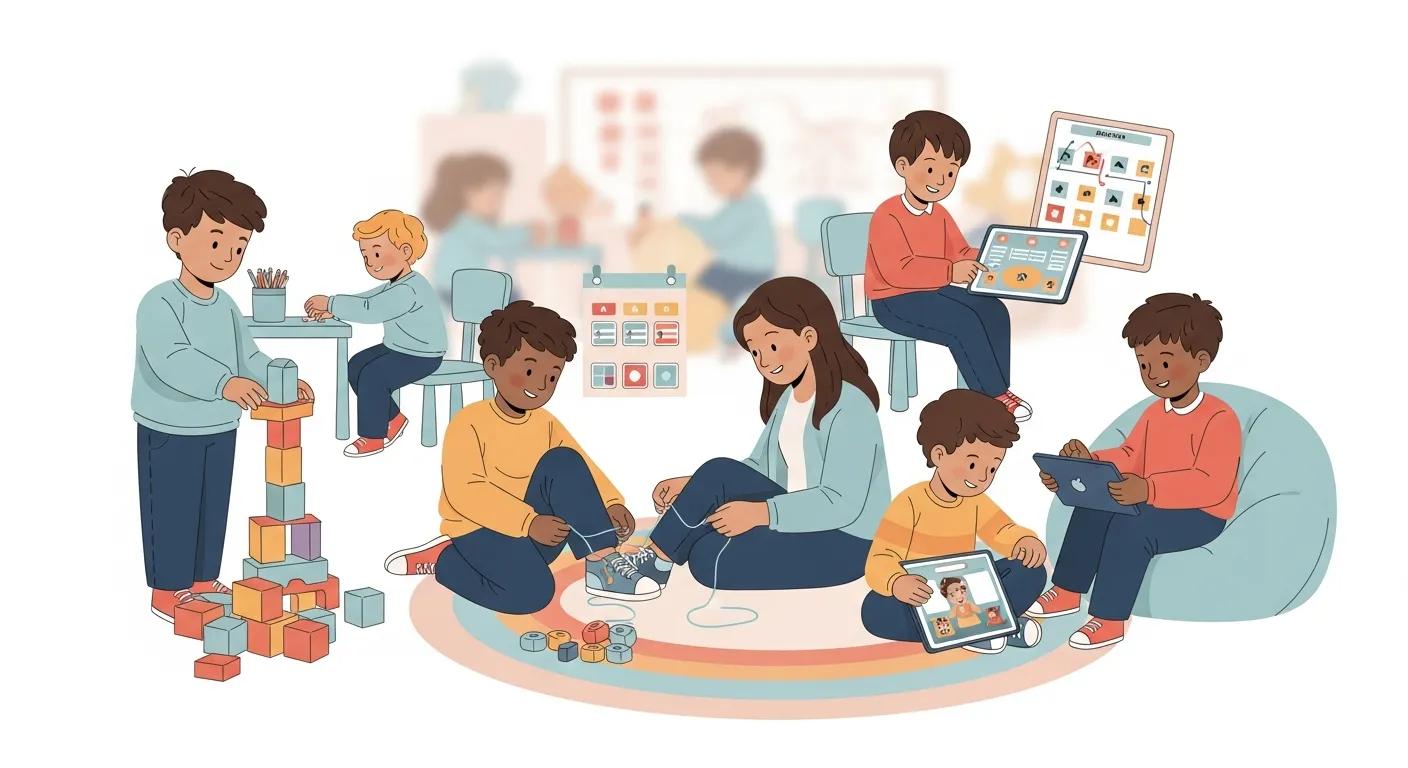
Social skills shape how autistic children connect with peers and manage everyday life. Applied Behavior Analysis (ABA) therapy helps build those skills. This article explains how ABA supports social growth, outlines its principles and common challenges, lists effective techniques, and describes how parents and caregivers can help. By understanding how ABA therapy works, parents can better support their children to overcome social communication barriers and reach more meaningful interactions.
ABA is a structured method based on behaviorism that aims to improve social skills in autistic children. It examines how behavior links to the environment and uses tools like positive reinforcement to encourage helpful actions. Its main strength is creating individualized treatment plans tailored to each child's needs, which supports better social communication.
Applied Behavior Analysis rests on several core principles that guide autism intervention. These principles include:
These principles let ABA therapists design targeted strategies to help children develop social skills.
ABA targets specific social skills with techniques such as role‑playing to practice interactions and visual supports like social stories and charts to clarify social cues. When started early, ABA often produces larger gains—children who begin therapy younger frequently show greater improvement in social skills.
Autistic children commonly face social challenges that can limit friendships and participation in social activities, so early support is important.
Common signs of social communication deficits in autistic children include:
Spotting these signs is the first step toward providing effective support.
Early intervention makes a real difference. Research shows that timely ABA therapy helps children develop social skills more effectively. Benefits of early intervention include:
A comprehensive meta‑analysis supports the strong positive effect of early intervention on social communication outcomes for young children with autism spectrum disorder.
Early Intervention Impact on Autistic Children's Social Communication
This meta-analysis examined the effects of early interventions on social communication outcomes for young children with autism spectrum disorder. A systematic review of the literature included 1442 children (mean age 3.55 years) across 29 studies. The overall effect size of intervention on social communication outcomes was significant (g= 0.36). The age of the participants was related to the treatment effect size on social communication outcomes, with maximum benefits occurring at age 3.81 years. Results did not differ significantly depending on the person implementing the intervention.
The effects of early intervention on social communication outcomes for children with autism spectrum disorder: A meta-analysis, AP Kaiser, 2020
Several ABA techniques help train social skills by strengthening interaction and communication abilities.
Behavioral interventions teach social skills. Techniques include:
They provide a structured space where children can learn and practise new skills.
Structured ABA methods are key to teaching social skills effectively. Key components include:
These methods give consistent, effective training so skills stick.
Parents and caregivers are key partners in ABA; their involvement improves intervention outcomes.
Parent training equips caregivers to reinforce ABA techniques at home. Programs often include:
These programs help parents take an active role in their child's development and progress.
Caregivers can use practical strategies at home to reinforce social communication:
Active caregiver involvement has a major positive impact on a child's social development.
Measuring progress helps teams see what's working and where to adjust the plan.
Progress can be tracked with methods such as:
Consistent tracking keeps therapy focused and effective.
Research and family reports show ABA can improve social skills for many autistic children. When delivered early and consistently, ABA often leads to better social communication, smoother integration into social settings, and improved quality of life.
A recent study examines the specific impact of ABA programs on autistic children's emotional and social skills and highlights the ongoing need for research in this area.
ABA Therapy for Autistic Children's Emotional-Social Skills
This study focuses on the potential of Applied Behavior Analysis (ABA) to improve emotional and social skills in children with autism spectrum disorder. ABA is a well-established therapeutic approach that uses behavior modification techniques to encourage positive behaviors and reduce challenging ones. Despite its widespread use, further research is needed to better understand its specific impact on emotional and social development in autistic children.
The effectiveness of applied behavior analysis program training on enhancing autistic children's emotional-social skills, 2024
ABA continues to evolve as new research and techniques emerge to better support autistic children.
Culturally sensitive ABA adapts interventions to fit a family's background. This includes:
These approaches aim to make therapy more inclusive and effective for diverse families.
To support these efforts, practical guides are being developed to help behavior analysts create culturally adapted, clear, and comprehensible intervention materials for parents of autistic children.
Culturally Adapted ABA Training for Parents of Autistic Children
Behavior analytic interventions for people with disabilities often rely on implementation by novice caregivers and staff. One potential way to increase efficacy of intervention materials is to improve the cultural sensitivity and comprehensibility of these documents. This tutorial includes tips learned from health communication research to give step-by-step guidance on creating comprehensible, culturally adapted intervention plans through the example of training for parents of autistic children.
Culturally sensitive behavior intervention materials: A tutorial for practicing behavior analysts, A Mahoney, 2022
Recent studies stress that early intervention supports better long-term social outcomes. Children who start ABA at a young age are more likely to develop key social skills, improving relationships and community integration. Timely access to services can meaningfully change a child's social development path.
Our friendly team is here to help!
Book a call with one of our Clinical Directors today!