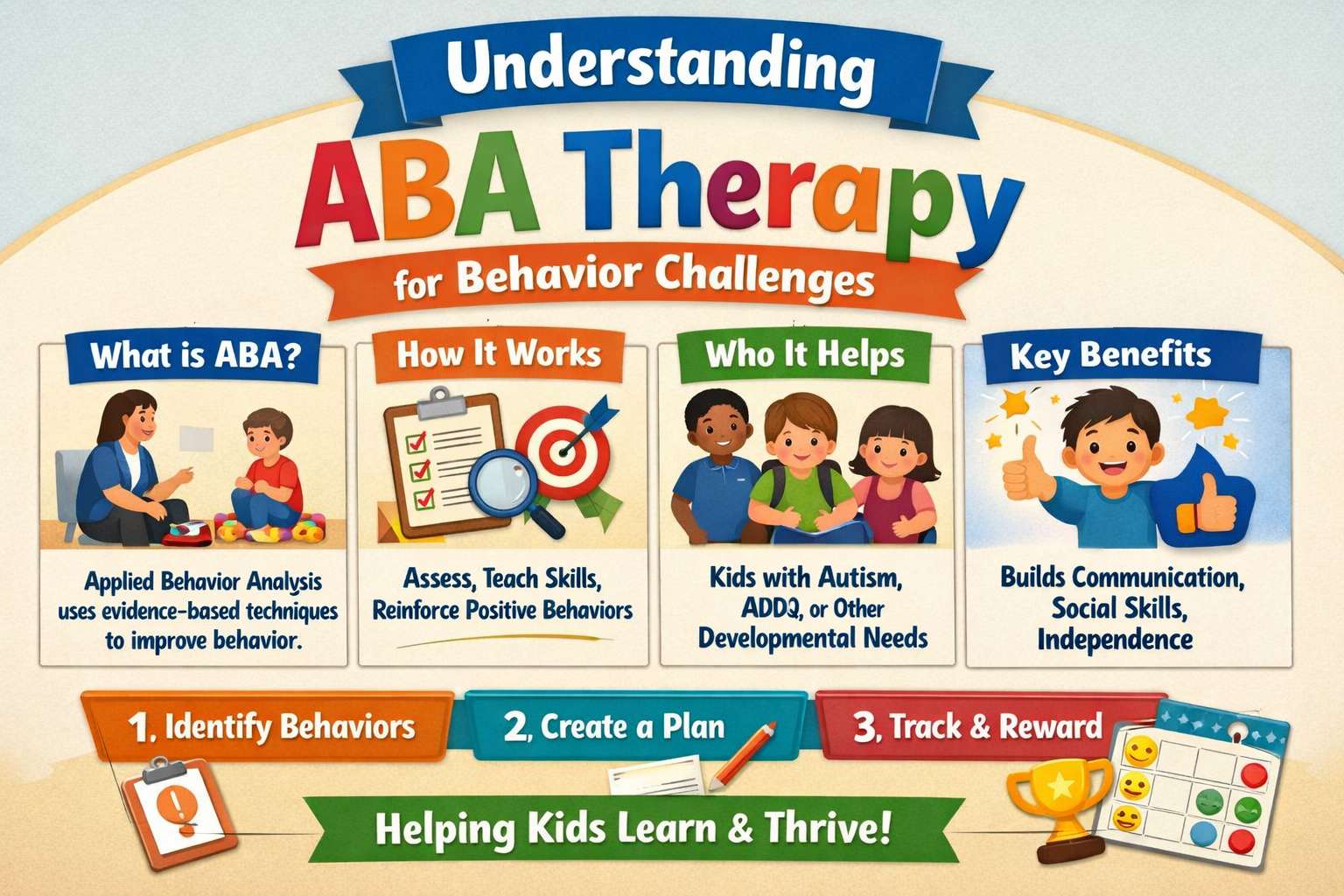
Applied Behavior Analysis (ABA) therapy is a scientifically validated method for addressing behavior challenges, especially in people with Autism Spectrum Disorder (ASD). This guide explains ABA’s core principles, its evidence base, and the techniques practitioners use. Many families struggle with behaviors linked to autism and need clear, effective strategies. ABA provides a structured framework that targets specific behaviors while supporting overall learning and development. Here we cover what ABA is, key techniques, the value of early intervention, and practical ways parents can support progress at home.
ABA is a systematic approach that applies behavior-analytic principles to improve socially significant actions. It studies how behavior and the environment interact so practitioners can design targeted interventions. Core elements include reinforcement, prompting, and data collection. Those elements let teams track progress and make informed changes. Used this way, ABA can improve communication, social skills, and daily living abilities.
Research shows ABA plays a key role in fostering language development in autistic children.
ABA Therapy for Language Development in Autistic Children
This study describes (1) the effectiveness of the Applied Behavioral Analysis (ABA) model in increasing language skills in autistic children and (2) language development after learning ABA methods. The authors conclude that Lovaas’s ABA method demonstrates effectiveness across phases and techniques.
Effectiveness of ABA therapy for children with special needs of autism: A study of psycholinguistics view, S Ithriyah, 2022
Applied Behavior Analysis (ABA) is grounded in behaviorist principles that emphasise the role of the environment in shaping behavior. The core principles of ABA include:
These principles form the basis for tailored interventions that meet each individual's needs.
ABA tackles behavior challenges by using individualised strategies that focus on a behavior’s function, not just its form. Functional behavior assessments identify why behaviours occur—tantrums, withdrawal, or other responses. With that insight, therapists teach alternative, more appropriate behaviours. Many children show clear gains in communication and social interaction after ABA.
Further research highlights how functional behavior assessments help reduce problem behaviors.
FBAI Effectiveness in Reducing Problem Behaviors
This review compared functional behavior assessment-based interventions (FBAI) with non-functional behavior assessment-based interventions (NFBAI) across 24 single-case design studies. All reviewed studies found FBAI more effective than NFBAI at reducing problem behaviors, showing a higher percentage of behavior reduction under FBAI conditions.
Comparing functional behavior assessment-based interventions and non-functional behavior assessment-based interventions: A systematic review of outcomes and …, 2020
Several ABA techniques reliably change behavior. They use structured, evidence-based methods to teach new skills.
Positive reinforcement rewards desired behaviors to increase their return. Rewards can be praise, tokens, or other motivators. Functional behavior assessments identify which behaviors need attention and the contexts in which they occur. That understanding lets therapists design strategies that address underlying causes.
Common strategies employed in ABA therapy include:
Practitioners tailor these strategies to each child to keep interventions effective and engaging.
Starting ABA early greatly increases the chance of positive outcomes. Research shows earlier therapy often leads to bigger gains in behavior and development.
Starting ABA therapy early can lead to numerous benefits, including:
Studies show early intervention boosts long-term development across multiple areas.
Multiple studies and meta-analyses consistently support early intensive behavioral intervention for young children with ASD.
EIBI Effectiveness for Young Children with ASD
This paper reviews five meta-analyses of early intensive behavioral intervention (EIBI) for young children with autism spectrum disorders published in 2009 and 2010. Four of the five meta-analyses concluded EIBI was an effective intervention strategy for many children with ASDs. The paper also discusses confounds and limitations that affect these conclusions.
Overview of meta-analyses on early intensive behavioral intervention for young children with autism spectrum disorders, 2012
Research shows early intervention improves long-term outcomes. Young children in ABA often become more adaptable and resilient socially. Early therapy can reduce the severity of behavior challenges and ease transitions to school and community settings.
Parents and caregivers are key to reinforcing ABA at home. Their consistent support boosts the effectiveness of therapy.
Parent training teaches caregivers how to use ABA techniques like reinforcement and prompting. This training builds skills, strengthens the parent–child bond, and keeps strategies consistent across settings.
To effectively reinforce ABA techniques at home, parents can:
Using these tips keeps progress moving between sessions.
Clinical professionals ensure ABA is implemented safely and effectively. Their training helps tailor ethical, evidence-based interventions.
Many ABA clinicians hold certifications like the Board Certified Behavior Analyst (BCBA). This shows they met rigorous education and experience standards. Clinicians use observation and data analysis to guide and personalise interventions.
Ethics are central in ABA. Practitioners must respect each person's dignity and rights and deliver culturally sensitive care. Understanding a family's background and values improves therapy fit and results.
Measuring progress tells teams whether interventions work and what to change.
Various tools and metrics are used to assess behavior changes in ABA therapy, including:
These tools let practitioners make data-driven decisions about therapy.
Recent studies show children in ABA often make meaningful gains in communication, social skills, and adaptive behavior. Ongoing research seeks new techniques to improve ABA and keep it responsive to changing needs.
If you're interested in learning more or seeking support, you can contact us for personalized guidance.
Our friendly team is here to help!
Book a call with one of our Clinical Directors today!