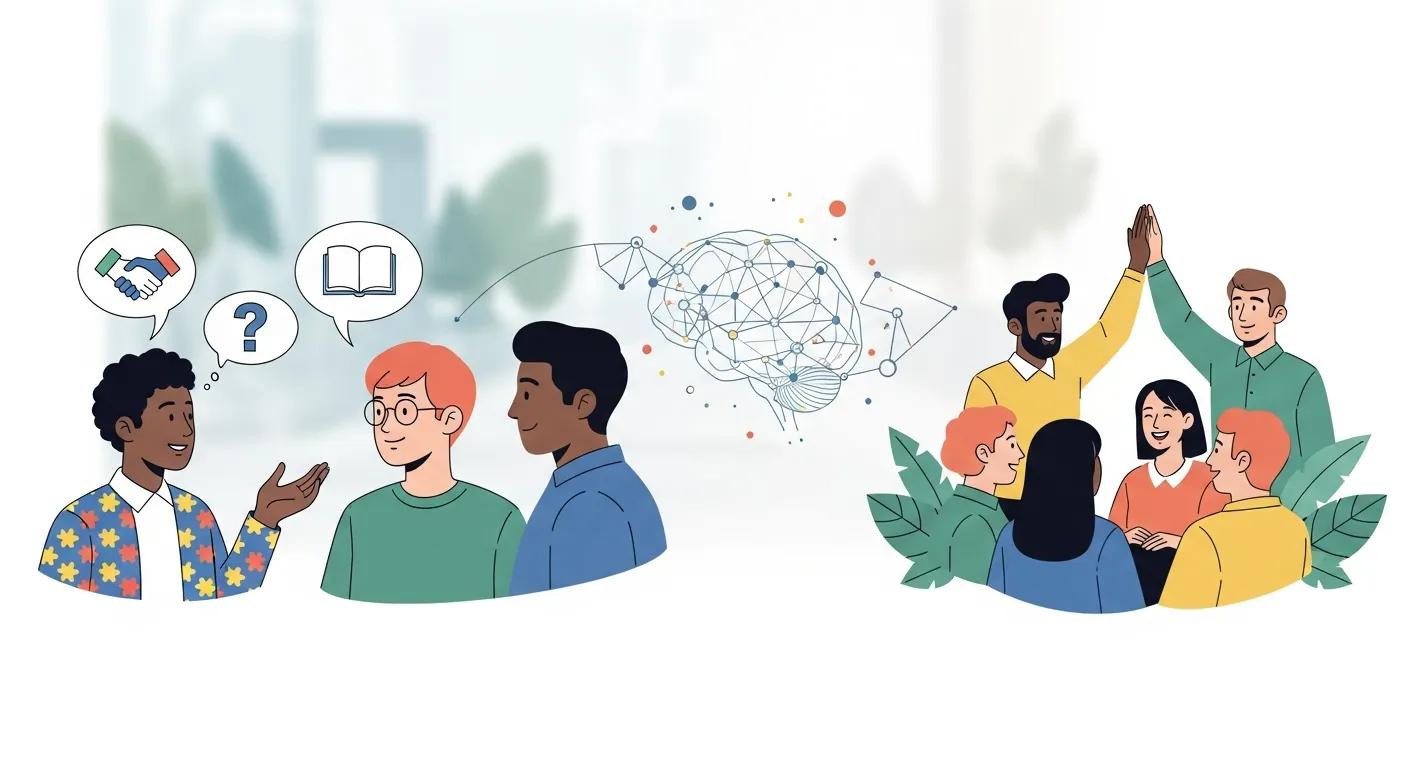
Social skills therapy for autism strengthens communication and interaction. It teaches practical social skills that improve relationships and ease anxiety in social settings. When families and caregivers understand how the therapy works, they can better support skill development. This guide covers why social skills therapy matters, how Applied Behavior Analysis (ABA) helps, caregiver roles, clinical best practices, outcome measurement, and resources for families.
Social skills therapy is a structured program that helps people with Autism Spectrum Disorder (ASD) learn key communication and interaction skills. It targets common challenges, like reading social cues and starting conversations. With focused work, therapy can boost peer interactions and lessen isolation.
ASD often makes social communication harder. People may miss facial expressions, body language, or tone of voice. That can cause misunderstandings and make it tough to form friendships, which slows social development.
The core goals of social skills training for autism include:
Overall, these goals aim to improve daily social interactions and emotional well‑being for people with autism.
Applied Behavior Analysis (ABA) is a widely used approach that helps build social skills in autistic individuals. ABA therapy applies behavior‑change principles to teach new skills and reinforce positive actions through structured practice.
Ongoing research examines ABA's specific effects on emotional and social development in autistic children.
ABA Therapy for Emotional & Social Skills in Autistic Children
This study examines the potential of Applied Behavior Analysis (ABA) to improve emotional and social skills in children with autism spectrum disorder. ABA is an established approach that uses behavior modification techniques to encourage positive behaviors and reduce challenging ones. Despite wide use, more research is needed to clarify its specific effects on emotional and social development in autistic children.
The effectiveness of applied behavior analysis program training on enhancing autistic children's emotional-social skills, 2024
The principles of ABA therapy in social skills therapy include:
These principles create a predictable, supportive setting that helps people learn skills and use them in real life.
Several ABA techniques have proven effective in enhancing social interaction skills for individuals with autism:
These methods give clear steps and practice so individuals can handle social situations more confidently.
Naturalistic behavioral approaches, such as Natural Environment Training, have strong evidence supporting their use for teaching a range of skills.
Naturalistic Behavioral Approaches for Social Skills in ASD
Naturalistic behavioral approaches are designed for children with ASD and have a solid evidence base, earning an “established” evidence level from the National Research Council (2001), the National Autism Center (2009), and the National Professional Development Center on Autism Spectrum Disorders (2011). These treatments effectively teach language, play, and social skills in children, adolescents, and adults with ASD (Goldstein 2002; Matson et al. 1996; Schreibman and Anderson 2001).
Natural environment training, 2014
Parents and caregivers are central to successful social skills work. Their day‑to‑day support helps therapy gains transfer to real life and last over time.
Parents can support and reinforce social communication at home by:
Simple, consistent routines and play-based practice make it easier for children to use skills outside therapy.
Caregiver training is essential for enhancing therapy outcomes for children with autism. Effective training programs focus on:
When caregivers learn practical strategies, progress in therapy is more likely to transfer to daily life.
Clinical professionals are key to delivering effective social skills therapy. Following best practices ensures care is effective and respectful.
Clinicians can deliver compassionate ABA guidance by:
Personalised plans and family collaboration help build trust and improve outcomes.
Recent evidence-based methods for autism social skills training include:
These approaches emphasise measurable progress and real‑world practice to support lasting skill gains.
Measuring therapy success shows what works and what needs adjusting. Clinicians use tools and observations to track changes in social communication and interaction.
Tools used to assess improvements in social communication and interaction include:
These measures supply concrete data to guide treatment choices and tweaks.
Typical therapy outcomes for children receiving social skills training include:
Such outcomes show how targeted social skills work can improve everyday life for children with autism.
Families looking for support can access a range of resources to learn and apply effective strategies.
Families can find additional information and professional help through:
These options can help families connect with professionals, peers, and funding to support therapy.
Teletherapy has adapted social skills interventions to improve accessibility by:
For more information or to seek guidance, consider contacting us. Teletherapy gives families a flexible, effective way to access social skills support regardless of location.
While face‑to‑face social skills training remains common, digital interventions are increasingly studied for their reach and practicality.
Social Skills Training for ASD: In-Person vs. Tech Interventions
Social skills training (SST) for autism spectrum disorder (ASD) has traditionally focused on face-to-face (F2F-SST) interventions. Recently, Behavioral Intervention Technologies (BITs-SST) have been used to address social skills deficits with computer programs, avatars, and therapeutic robots. This meta-analysis reviews evidence and compares 14 F2F-SST and four identified BITs-SST trials for youth with ASD.
Social skills training for autism spectrum disorder: A meta-analysis of in-person and technological interventions, CL Beard, 2021
Our friendly team is here to help!
Book a call with one of our Clinical Directors today!